8 Best ChatGPT Alternatives in 2026
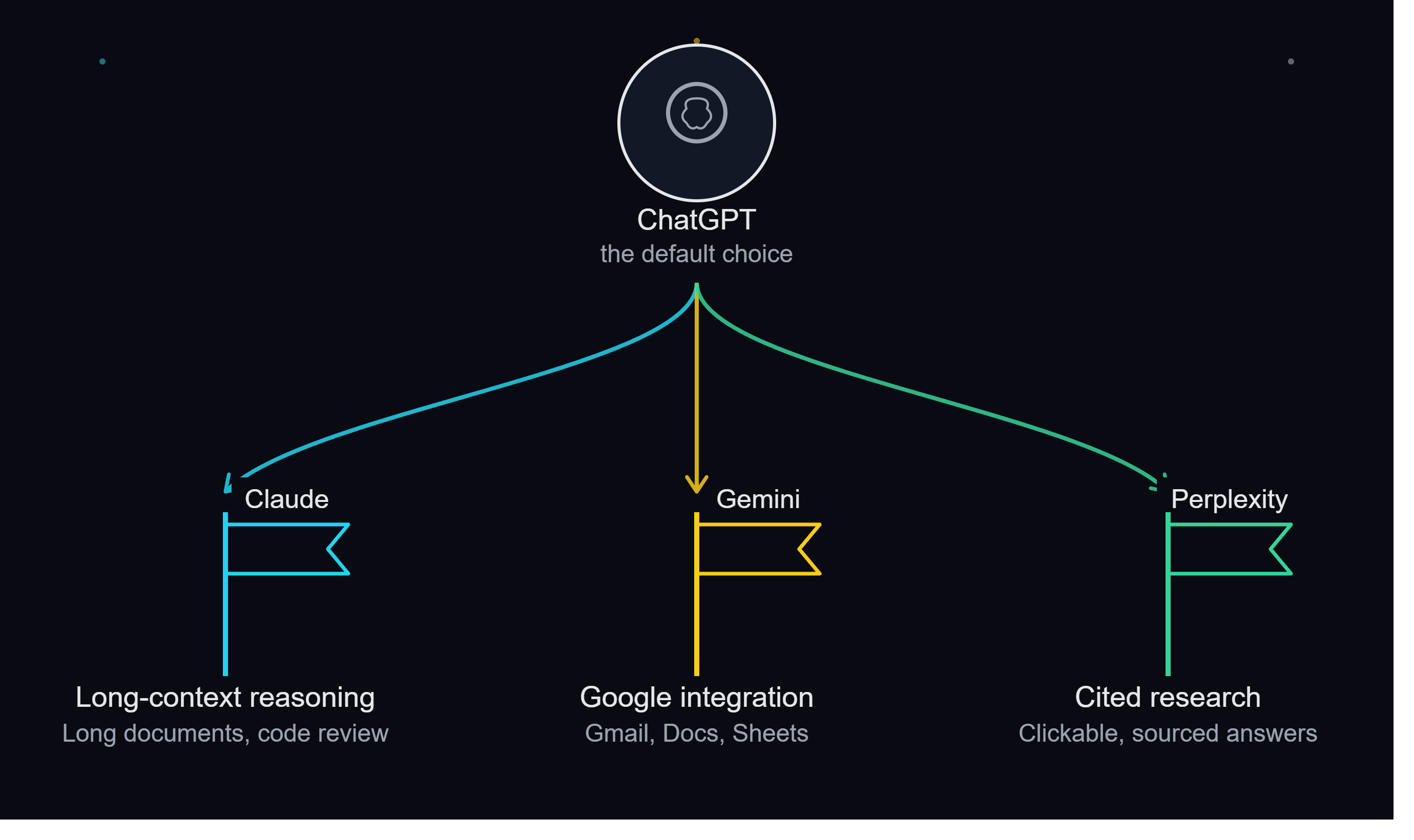
ChatGPT is the default choice for many people, but several alternatives are worth considering depending on exactly what you need it for. Here are the strongest options across chat, research, coding, writing, and workspace use.
For careful, long-context reasoning: Claude
Claude is our top overall pick, particularly for long documents and code review. Its larger context window and more careful, less generic writing style make it the stronger choice when you're working with big files or need prose that reads as genuinely considered rather than generic.
For Google integration: Gemini
Gemini is the natural choice if you already live in Gmail, Docs, and Sheets. It shows up directly inside the apps you're already using, and its very large context window is useful for digesting long reports or even video content in a single pass.
For research with citations: Perplexity
Perplexity answers questions with clickable, cited sources instead of an unsourced wall of text — ideal for research tasks where you need to verify a claim rather than just trust a confident-sounding answer.
For marketing copy at scale: Jasper AI and Copy.ai
If what you actually use ChatGPT for is marketing copy, Jasper AI's Brand Voice training and Copy.ai's genuinely free plan are both more purpose-built for that specific job than a general chatbot, with templates that get you to a usable draft faster.
For in-editor coding help: GitHub Copilot and Cursor
ChatGPT's Code Interpreter is useful for quick scripts, but GitHub Copilot and Cursor are built directly into your editor, with inline suggestions and — for Cursor specifically — an agent mode that can plan and execute multi-file changes.
For workspace-embedded help: Notion AI
If your team already organizes work in Notion, Notion AI can summarize meeting notes and answer questions using your own workspace content directly, something a general-purpose chatbot has no access to do at all.
Choosing based on what you actually do
There's rarely a single "best" alternative — the right one depends on whether your main use case is long-form writing, research, coding, marketing, or workspace productivity. Many of the tools above are complementary rather than competing, which is why it's common to keep more than one active subscription rather than replacing ChatGPT outright.
See the full list
Check our full chatbots rating for every alternative we've tested, ranked by capabilities, quality, and price, or browse all categories for a shortlist matched to a more specific task.
Don't feel locked into just one
Since several of the tools above have a genuinely usable free tier, there's little downside to keeping more than one active rather than picking a single permanent ChatGPT replacement. A common pattern among our own editorial team is a daily-driver chatbot for general writing and reasoning, plus a second tool opened specifically for the one task it handles better — sourced research, in-editor coding help, or workspace-specific Q&A — rather than expecting any single alternative to cover every use case ChatGPT does.
A simple way to decide if you're stuck
If you genuinely can't decide, start with whichever alternative is free and already connected to something you use daily — Gemini if you're a heavy Gmail or Docs user, otherwise Claude's free tier for its careful, long-context writing. Add Perplexity the next time you catch yourself wanting to double-check a fact a chatbot gave you, since verifying claims against live, cited sources is exactly the gap it's built to close, and few of the other alternatives do that as directly.
Revisit this list every few months regardless of what you pick today — all of the tools above ship meaningful updates often enough that a gap you noticed recently may have already narrowed by the time you check back.