ChatGPT vs Claude: Which AI Is Better in 2026?
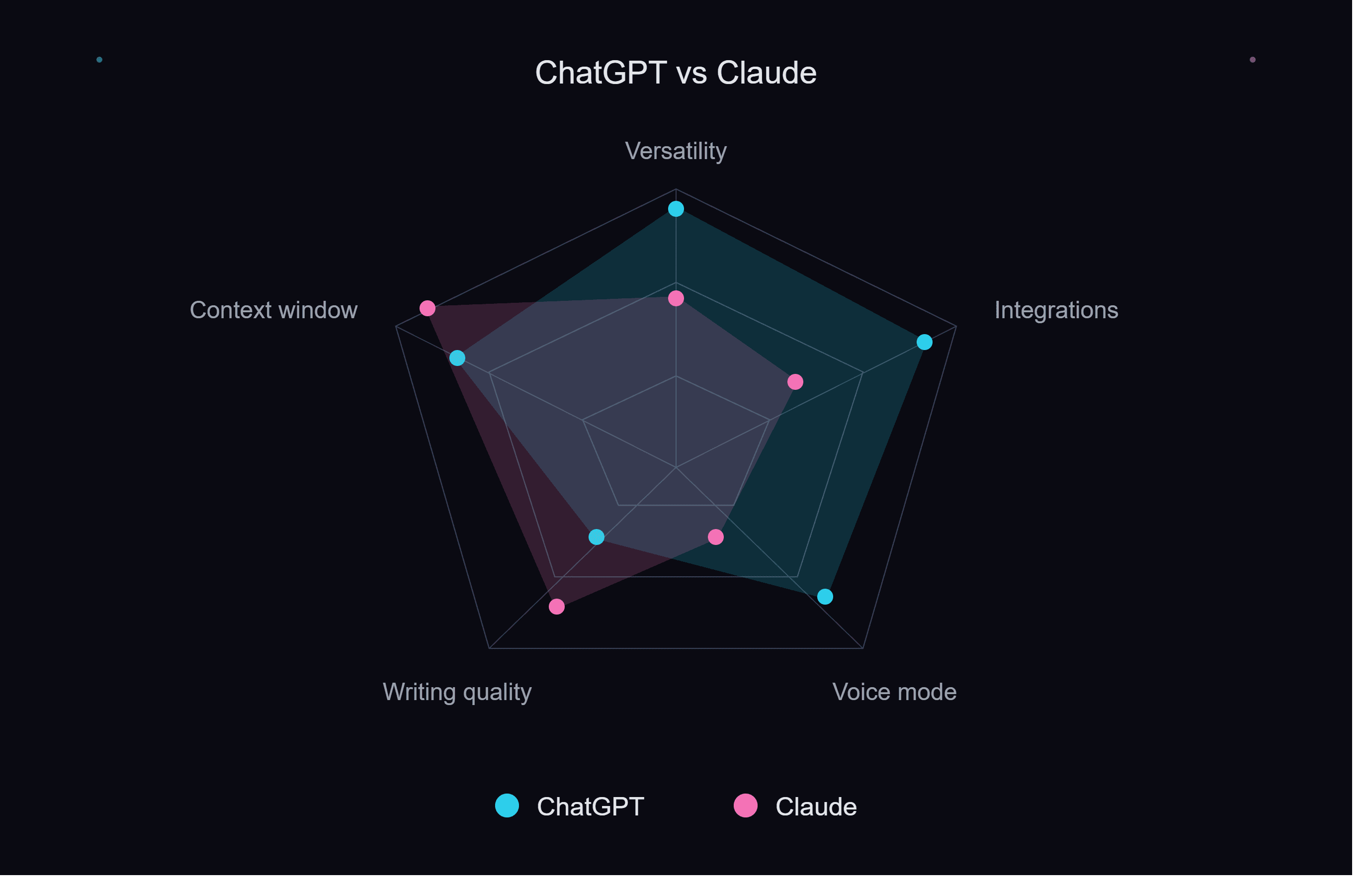
ChatGPT and Claude are the two most capable general-purpose AI assistants available, and the right pick depends on what you value most — breadth of features or careful handling of long, complex work.
Where ChatGPT wins
ChatGPT is more versatile day-to-day, with native voice mode, a huge Custom GPT ecosystem, and tight integration across OpenAI's other products, including DALL-E 3 for image generation directly inside the same chat. Canvas gives it a dedicated side-by-side editing surface for documents and code, and its web browsing mode lets it pull in current information beyond its training data.
Where Claude wins
Claude tends to produce more careful, less generic writing, and its larger context window makes it a better fit for big documents or large codebases in a single conversation. Our testing also found its code suggestions come with more thoughtful edge-case handling, and it's noticeably more willing to flag its own uncertainty on ambiguous questions rather than answering with unwarranted confidence.
Pricing and limits
Both tools use nearly identical pricing: a usable free tier, then $20/mo for Plus or Pro, which removes most day-to-day usage limits. Neither is meaningfully cheaper, so price shouldn't be the deciding factor between them — the real constraint either way is how much you'll bump into free-tier limits during a heavy day of use.
Ecosystem and extensibility
ChatGPT's Custom GPT store is significantly larger than anything in Claude's ecosystem, which matters if you rely on pre-built configurations other people have already made for a specific task. Claude's equivalent, Projects, is more about organizing your own long-running work with persistent context than browsing a marketplace of community creations.
Voice and multimodal features
ChatGPT's native voice mode makes it usable hands-free in a way Claude currently doesn't match, and its image generation and understanding are built directly into the same chat window. Claude can read and analyze images and files you upload, but has no native image-generation capability of its own.
Full side-by-side
For a detailed feature and pricing breakdown, see our ChatGPT vs Claude comparison or check the full rating for how each scores against every other tool we test.
Bottom line
If you want the most flexible all-rounder with the widest feature set, ChatGPT is the safer default. If you're working with long documents, big codebases, or want the most careful writing and code review, Claude — our top-rated tool overall — is worth the switch.
Memory and ongoing projects
ChatGPT's memory feature quietly carries facts and preferences across separate conversations, so you rarely need to re-explain context from scratch. Claude's Projects take a more deliberate approach, scoping context to a specific body of work rather than following you everywhere — useful for anyone who wants client work or separate projects kept cleanly isolated rather than blended into one running memory across every unrelated chat.
Trying both before committing
Because both have a genuinely usable free tier, there's little cost to running the exact same real task — a document you need written, a piece of code you need reviewed — through both before deciding which one to pay for. Generic demo prompts tend to make both tools look similarly impressive; your own actual recurring task is a far more reliable way to judge which one's particular strengths, long-context handling versus broader feature set, actually matter for how you work day to day.
Whichever you end up paying for, it's worth re-checking this comparison every few months — both companies ship meaningful model updates often enough that a gap favoring one tool today can narrow or reverse within a single release cycle.