How to Use ChatGPT for SEO: A Practical Guide
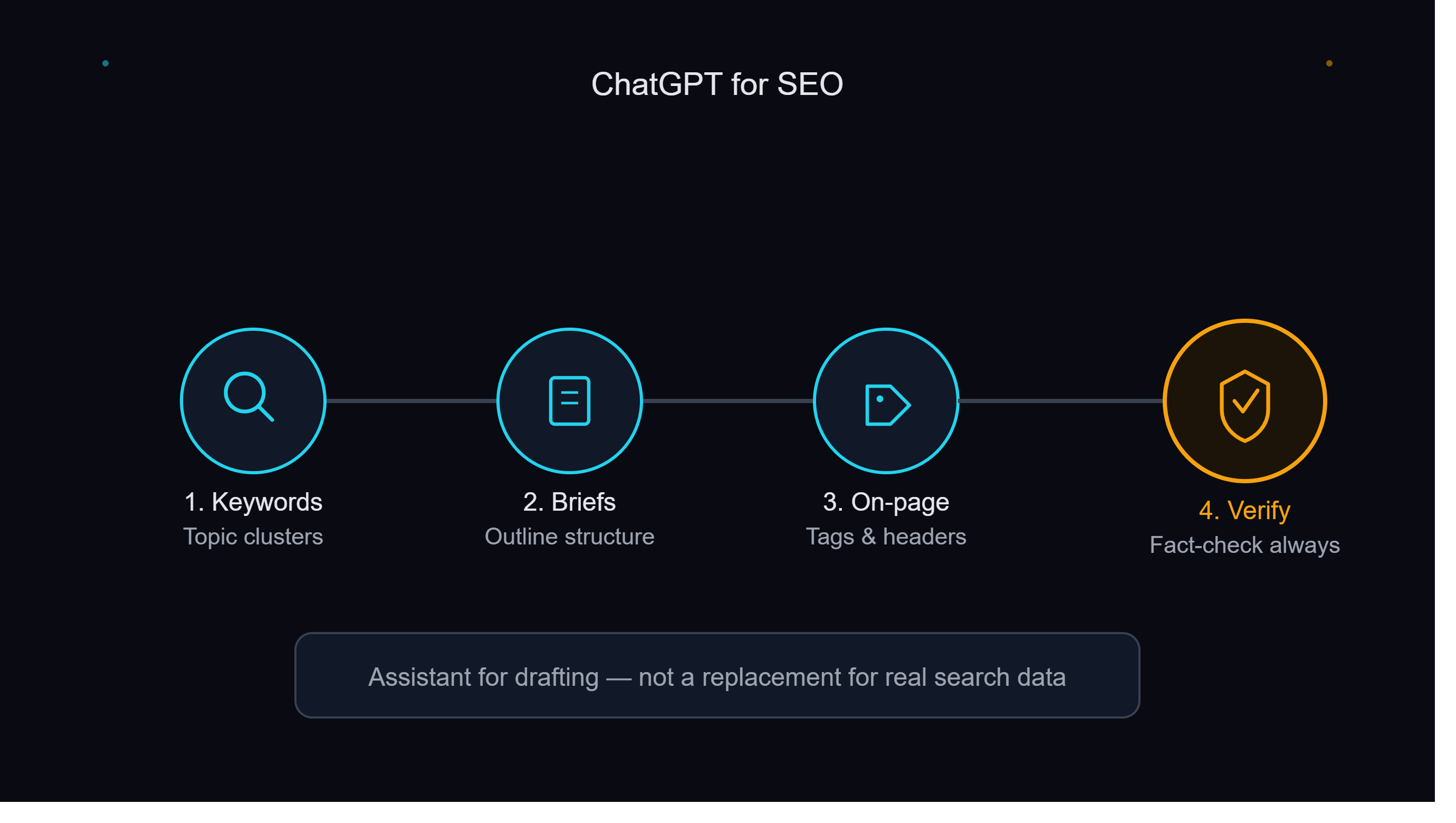
ChatGPT can meaningfully speed up SEO workflows, but it works best as a research and drafting assistant, not a replacement for real search data or a dedicated optimization tool.
1. Keyword and topic research
Ask ChatGPT to brainstorm topic clusters and related questions around a seed keyword, then verify actual search volume with a dedicated keyword tool. ChatGPT is good at generating a wide net of related angles and questions quickly, but it has no access to real, current search-volume data on its own.
2. Content briefs
Use ChatGPT to draft an outline covering the subtopics competitors typically address — this speeds up brief creation but should still be checked against real SERP data. A reasonable workflow is asking it to list the subtopics a thorough article on the keyword "should" cover, then cross-checking that list against what's actually ranking before finalizing the brief.
3. On-page optimization
ChatGPT can suggest title tags, meta descriptions, and header structure, though a dedicated tool like Surfer SEO will score content more precisely against top-ranking pages. Surfer's live content score is grounded in what's actually ranking right now for a specific query, which ChatGPT's general knowledge can't replicate on its own.
4. Drafting and rewriting
Once you have a brief, ChatGPT can turn it into a full first draft reasonably quickly, especially for straightforward informational content. Be specific about tone, target reader, and word count in the prompt — vague requests tend to produce noticeably more generic-sounding output than a prompt that gives ChatGPT real constraints to work within.
5. Don't skip fact-checking
Always verify statistics and claims ChatGPT generates — see our full rating for tools better suited to citation-backed research, like Perplexity, which cites a live source for every claim it makes rather than answering from memorized training data alone.
6. Where ChatGPT alone falls short
ChatGPT has no way to see your actual rankings, backlink profile, or technical SEO issues, and a high-quality draft doesn't guarantee it will rank. Treat it as one part of an SEO workflow — research and drafting — rather than a full substitute for keyword tools, rank tracking, or technical audits.
A realistic weekly workflow
A practical setup many SEO teams use: ChatGPT for initial topic brainstorming and first-draft writing, a dedicated keyword tool for real search-volume validation, and Surfer SEO for scoring the draft against actual ranking pages before publishing. Each tool covers a different gap the others don't, which is why combining them tends to outperform relying on ChatGPT alone.
Common mistakes to avoid
The most common misstep is treating ChatGPT's output as a finished answer rather than a first pass — publishing a ChatGPT-drafted brief or article without checking it against real SERP data or verifying its factual claims is how thin, inaccurate content ends up live. A close second is vague prompting: asking for 'an SEO article about X' produces noticeably more generic output than giving it a specific audience, angle, and the subtopics you already know competitors cover.
Treat it as one tool in a larger workflow
The teams who get the most out of ChatGPT for SEO don't rely on it alone for any single step — they use it to speed up research and drafting, then lean on a dedicated keyword tool for real search-volume data and a scoring tool like Surfer SEO before publishing. Each tool closes a gap the others leave open, and skipping the verification steps in favor of pure speed is consistently how thin, inaccurate, or poorly-targeted content ends up published.
Revisit this workflow periodically, too — ChatGPT's underlying model improves often enough that a limitation worth working around today may no longer apply in a few months, while the core discipline of verifying against real search data stays relevant regardless.